Deutsch

Following the success of mRNA vaccines against COVID-19, nucleic acid therapies have become one of the most important topics in modern biomedical research. The potential of these therapeutic agents extends far beyond vaccines and opens up new possibilities for the treatment of infections, genetic disorders, and various types of cancer. [1] However, the success of such therapies depends crucially on whether the therapeutic molecules reach their intended target in the body. This is precisely where “drug delivery” comes into play.
RNA, in particular, poses major challenges for researchers. It is sensitive, is rapidly broken down by enzymes in the body, and cannot cross cell membranes on its own. Therefore, the right formulation plays a central role. [1] Lipid nanoparticles (LNPs), which have already been successfully used in mRNA-based COVID-19 vaccines, have brought about a decisive breakthrough in this area. [2,3]
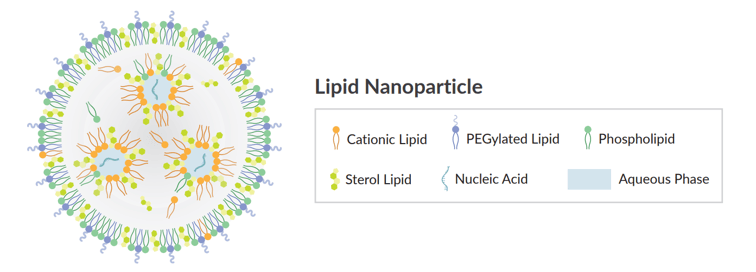
These are by no means simple fat droplets. LNPs are highly sophisticated nanostructures composed of several lipid components. The selection and combination of these lipids significantly influence stability, distribution within the body, and biological efficacy. Together, they form a protective shell for sensitive nucleic acids and enable their safe transport into target cells. Our partner, Cayman Chemical, provides an extensive range of lipids for this purpose, allowing LNP formulations to be individually tailored to different applications and biomolecules.
mRNA and Beyond:
Complex Packaging for Sensitive Nucleic Acids
A typical LNP formulation consists of ionizable lipids and several auxiliary lipids. Auxiliary lipids include, among others, sterols, glycerophospholipids, and PEGylated lipids. [5,6] Each of these components contributes in different ways to the structure, stability, and function of the nanoparticles. By carefully combining the lipids, the properties of the LNPs can be precisely tailored to the specific application.
In addition to the lipid composition, other factors influence the performance of the particles. These include, for example, the molar ratio of the lipids used, the ratio of lipids to nucleic acids, the nitrogen-to-phosphate ratio (N:P), the pKa values of the ionizable lipids, the particle size, and the route of administration. [5] These parameters directly affect the encapsulation efficiency, efficacy, tolerability, and pharmacokinetics of the formulation.
Ionizable Cationic Lipids
Ionizable cationic lipids were developed to mitigate the drawbacks of permanently positively charged lipids. Their charge changes depending on the pH. Under acidic conditions, they carry a positive charge and can thus interact efficiently with negatively charged nucleic acids. This facilitates the encapsulation of the nucleic acids within the LNPs.
At physiological pH, however, these lipids are largely uncharged. This reduces unwanted interactions with biological structures while still ensuring the transport of the therapeutic payload. This property contributes significantly to the good tolerability of modern LNP systems. [5,6]
| Lipid Name | Product number | pKa value of the tertiary amine
[5]
|
| 1,2-Dioleoyl-3-dimethylammonium propane (DODAP) | Cay25726 | 5.59 |
| 1,2-Dioleyloxy-3-dimethylamino-propane (DODMA) | Cay15109 | 6.59 |
| ALC-0315 | Cay34337 | 6.09 |
| DLin-MC3-DMA | Cay34364 | 6.44 |
| DLin-KC2-DMA | Cay34363 | 6.70 |
| SM-102 | Cay33474 | 6.68 |
Did you know?
SM-102-based lipid nanoparticles have established themselves as an important reference standard in the development of new LNP formulations due to their reliable and reproducible performance. In a technical report by Cayman Chemical, various formulations and payloads were investigated over a twelve-month period to evaluate the performance of these LNPs under different conditions.
Sterol Lipids
Sterol lipids, particularly cholesterol, are among the key building blocks of many LNP formulations. They influence the packing density and mobility of the lipid membrane, thereby contributing to particle stabilization. In addition, they can enhance interaction with cell membranes and support processes such as cellular uptake or endosomal escape. [5,6]
Certain cholesterol derivatives, including 7α-hydroxycholesterol, are specifically used to further optimize the efficiency of nucleic acid delivery. [5]
| Lipid Name | Product Number | Available sizes |
| Cholesterol | Cay9003100 | 100 g, 250 g |
| 7α-hydroxy cholesterol | Cay20098 | 1 mg, 5 mg, 10 mg, 25 mg |
Glycerophospholipids
Glycerophospholipids belong to the group of phospholipids and consist of a hydrophilic head group and two hydrophobic fatty acid chains bound to a glycerol backbone. The specific head group determines important properties of LNPs, including surface characteristics and charge distribution. [5]
Neutral and Anionic Phospholipids
Neutrally charged phospholipids can positively influence membrane flexibility and fusion with cell membranes. These include, among others, phosphatidylcholine (PC) and phosphatidylethanolamine (PE), which are frequently used in LNP formulations.
| Lipid Name | Product Number | Available Sizes |
| 1,2-Dioleoyl-sn-glycero-3-PE (1,2-DOPE) | Cay15091 | 100 mg, 250 mg, 500 mg |
| 1,2-Distearoyl-sn-glycero-3-PC (1,2-DSCP) | Cay15100 | 250 mg, 500 mg, 1 g |
| 1,2-Dioleoyl-sn-glycero-3-PC (1,2-DOPC) | Cay15098 | 250 mg, 500 mg, 1 g, 5 g |
| 1-Palmitoyl-2-oleoyl-sn-glycero-3-PC (1,2-POPC) | Cay15102 | 100 mg, 250 mg, 500 mg |
| 1-Palmitoyl-2-oleoyl-sn-glycero-3-PG (sodium salt) (1,2-POPG) | Cay15105 | 25 mg, 50 mg, 100 mg, 250 mg |
| 1,2-Dioleoyl-sn-glycero-3-PS (sodium salt) (1,2-DOPS) | Cay29983 | 5 mg, 10 mg, 25 mg, 50 mg |
PEGylated Lipids
PEGylated lipids play an important role in the stability and circulation half-life of LNPs. They reduce protein binding to the particle surface and can thereby minimize their premature clearance by the mononuclear phagocyte system. [5,6]
In addition, some PEGylated lipids possess functional end groups such as amino or maleimide groups.
| Lipid Name | Product Number | Available Sizes |
| DMG-PEG(2000) | Cay33945 | 500 mg, 1 g |
| ALC-0159 | Cay34336 | 25 mg, 50 mg, 100 mg, 500 mg |
Conclusion
Lipid nanoparticles are much more than simple fat droplets. It is the precise interplay of different lipid components that makes LNPs powerful delivery platforms for sensitive nucleic acids. But how are these complex nanoparticles actually formed, and what technologies are used in their production? The second part of our LNP series addresses these questions.
Curious to learn more?
Discover Cayman Chemical's entire portfolio or check out our blog for more exciting developments related to lipid nanoparticles and modern drug delivery systems.
Sources
[1] Ogris, M., & Wagner, E. (2011). To be targeted: is the magic bullet concept a viable option for synthetic nucleic acid therapeutics?. Human Gene Therapy, 22(7), 799–807.
[2] https://www.merckgroup.com/de/research/science-space/envisioning-tomorrow/lipid-nanoparticles.html, August 13, 2026
[3] https://www.pharmazeutische-zeitung.de/sensible-molekuele-komplex-verpackt-123339/, August 13, 2026
[4] Mendes, B.B., Conniot, J., Avital, A. , et al. Nanodelivery of nucleic acids. Nat Rev Methods Primers 2, 24 (2022).
[6] Hou, X., Zaks, T., Langer, R. , et al. Lipid nanoparticles for mRNA delivery. Nat Rev Mater 6, 1078–1094 (2021).
Preview image: https://www.caymanchem.com/lipid-nanoparticles